Who Jake Trinder is
Jake Trinder is the founder of Views To Clients (V2C), a YouTube growth company in
Newcastle upon Tyne that builds and runs business YouTube channels from scratch: research,
strategy, scripts, editing, thumbnails, publishing and lead tracking, with the client doing
nothing but record. Its clients have included Gary Vee, Ali Abdaal, Instantly and
Glencoco, and every result it publishes came from organic videos rather than paid ads.
Before V2C grew he was Head of YouTube at Clay.
With Niels Trinder he co-owns VideoCore, the channel-intelligence platform this page
sits on, which turns his way of reading a channel into free tools and measured reports. He
teaches the whole method in public on his own channel, and the longest lessons are written
up here as free guides, linked below.
How he got here, as he tells it
Jake started his first YouTube channel at ten, wanting a channel like the ones he watched.
The videos were bad, he says so himself, but he fell for the process: make something, post it,
watch fifty people choose to spend their time on it. At eleven or twelve, during the
fidget-spinner craze, he found a toy no retailer stocked, ordered it from a supplier and made
two videos on it. On a channel averaging a few hundred views they did tens of thousands. It was
the first time he had found a gap in the market on purpose. School was less kind about the
channel, and for years it went on the back burner.
At eighteen he left sixth form with A* grades in maths, further maths and computer science
and was turned down by almost every university he applied to, the places having gone to the
pandemic backlog. After a long night of argument his parents agreed a bet: a gap year, and if he
was making ten thousand dollars a month by the end of it he did not have to go. He learned basic
web design in two days, knocked on more than a hundred doors in Newcastle, and sold one website
for sixty pounds.
Two weeks later a business owner posted that they were hiring a YouTube editor to grow the
company channel. Jake recorded a pitch within the hour offering to run the whole channel
instead: ideas, thumbnails, scripts, posting, everything. The owner said yes, at 1,700 dollars a
month. He reports that eight months later the channel had added over a million dollars a year
to that business, from zero. He wrote it up as a fifty-page case study, and the document brought
the next clients. At the end of the gap year his parents asked whether he had hit ten thousand
a month. He had not. He reports he had done fifty thousand that month.
“I just love the process of YouTube too much. This was my passion at the time, and this was the way for me to explore my problem-solving brain.”
Jake Trinder, How YouTube Changed My Life
- Sept 2022Starts Views To Clients at eighteen, from a bedroom in Newcastle, in a gap year.
- 2023First fifty-thousand-dollar month before his nineteenth birthday, by his account.
- 2026A team of more than twenty full-time people plus freelance editors, working from Newcastle, as he described it in June 2026.
Company figures in this section are as Jake states them on his own channel, dated by him. They are company revenue, not personal income, and VideoCore has not audited them. The figures in the next section are ours.
His channel, measured the way he measures everyone else’s
15,600subscribers
763,000total views
21public videos
February 2021on YouTube since
Public figures from the YouTube Data API, read 25 September 2026. Rounded.
Every video below is scored against his own channel’s median, which is the rule
VideoCore applies to any channel: a video’s multiple is its views divided by the median of
that channel’s comparable recent uploads. Subscriber counts and raw views are not used,
because they say nothing about whether a video did well for that channel.
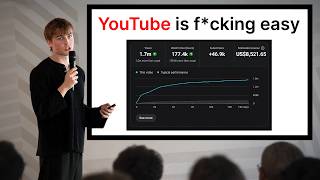
100× his channel median · 480,002 views · Sep 2026

3.1× his channel median · 4,125 views · Jun 2024

3.0× his channel median · 6,298 views · Jun 2026

2.8× his channel median · 13,311 views · Sep 2026

2.7× his channel median · 12,724 views · Sep 2026

0.7× his channel median · his own story
Multiples and view counts from the VideoCore harvest of 17 September 2026. The
100× talk was nine days old at the time; the multiple will settle as the baseline catches up.
Dollar figures in his titles are his claims about clients and his own business, quoted as
titles; VideoCore has not measured them.
The way he works: 18 principles
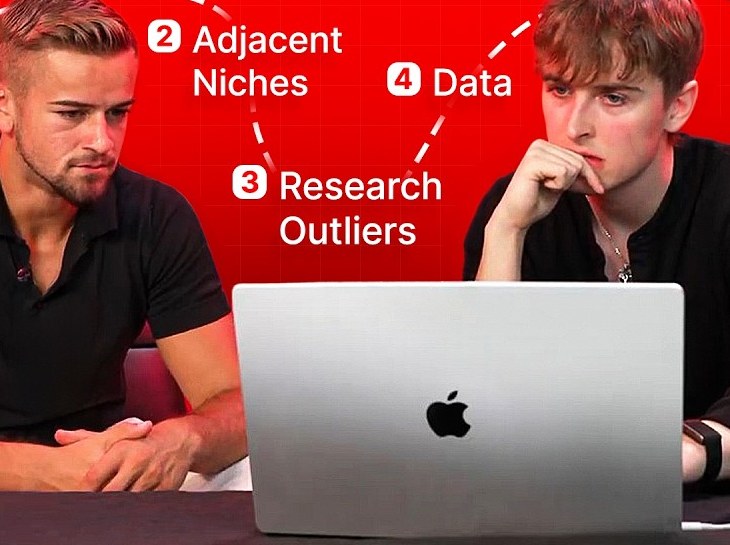
These are codified from his own videos (most recently his training talk and his October 2026 podcast) and are the lens every VideoCore report and sales
pack is judged through. They supply the questions; the channel’s data supplies the answers.
- The business comes firstA channel exists to bring the business customers. Subscribers are not the goal; views from the right people are, and the offer behind the links decides what the channel should make.
- Pick a niche you can winThe niche is the one the validated product already serves. Three tests: a product that sells, an informational edge (real expertise), and a market large enough for the arithmetic. A tight niche gives a fast feedback loop in the first 30 to 90 days.
- Understand the audience deeper than feels reasonableWhat they search for, fear, want and say, in their own words. The biggest cost on a channel is the video that never gets conceived because nobody knew what the market wanted.
- Research before you ideateDepth-first: map adjacent niches, take seed search terms, find the videos that beat their own channel's norm, extract the pattern (subject, frame, packaging) and transfer it. Never brainstorm from a blank page.
- Package ruthlesslyTitle and thumbnail make one promise and the video must keep it. A bold promise honestly kept compounds; a promise broken teaches the algorithm to stop recommending. Start at step four and nothing compounds.
- Double down, retire; cadence is for learningMake more of what already beat the baseline and stop making what sits under it. YouTube is a quality game, not a quantity game: one video that wins can carry a channel, and no number of uploads rescues videos that are not good enough. A cadence matters while you are learning, because it is the feedback loop that tells you what works; it is not something the algorithm rewards on its own. Polish multiplies good content; it never substitutes for it.
- Sell without sellingDeliver the full value so the viewer could act without buying, and demonstrate the steps inside the product as you teach. The product is shown as the best vehicle, never pitched. The call to action names the offer, sits in the first two lines of the description and in the video where the value lands.
- Only what was measuredEvery claim carries its number from the database. What cannot be measured from outside the channel (click-through, retention, revenue) is named as not measured, never guessed.
- A video is a chain of decisionsTopic, packaging, opening, content, execution, then the read afterwards. One wrong decision can sink a video that got everything else right, and the wrong one is easy to misdiagnose: carry forward what was close to working and change only the link that broke. Do not move to the next stage until this one cannot be the point of failure; the sign an idea is right is being nervous to waste it. Quality means the quality of the decisions, not the camera or the editing.
- Prove the demand, then size the floor and the ceilingKnowing the audience is not proof they will choose the subject on YouTube. Find the videos on the subject that beat their own channel; the typical result is the floor (would a good video at that level still be worth making for the business?) and the best is the ceiling. When the viewer wants the outcome but not the mechanism, sell the outcome and let the unfamiliar mechanism be the reason it is new ("if you don't understand insulin, you don't understand fat loss").
- Stack demand to raise the ceilingOnce the floor is worth it, attach the subject to something the audience already chooses in greater numbers (a person, a product, an event they follow), so the video stands out and its total addressable audience grows: "Alex Hormozi's lead generation strategy" outperformed every plain lead-generation video and still ranks for the search term. The attachment must be true and relevant, never a borrowed name.
- Write the acceptance criteria before the outlineThe title is the program. Decompose its promise into every condition that must be true by the end for the title to be true, then break each down again to its smallest truthful component. That list is the outline, every item is a single point of failure, and the video is finished only when every condition passes. Retention is not the goal; satisfied viewers are, and the brain rewards what beats the expectation the click set.
- Take the reason it worked, not the wordsGaps are found by comparison: what wins in niches with the same viewer (Facebook ads and business) or the same intent behind the view (YouTube growth and Facebook ads: both want to grow), and is absent here. Before copying a winner, decide what drove it (title, thumbnail, structure, or the content itself) and check the negative evidence: how often the format failed, and why. A format can need its structure too ("I made 300 videos and learned this" works with 20-40 points, not a 3-point list).
- Win the glance, then the titleThe thumbnail is read first and in an instant: few elements, the result the viewer dreams of shown literally (a payment notification, the finished body), and plainly for them. The title then qualifies the exact promise. Go as broad as the claim allows without losing the core viewer: specificity costs reach, pay it only when the right person feels more understood. An asset everyone has copied stops interrupting the feed.
- Promise, proof, plan in the openingAfter the click the viewer asks: am I getting what I clicked for (promise: confirm it in the title's words), why should I listen to you (proof: the one result that makes you the person), how will you get me there (plan: the road map, so they commit to the length). Add persona when the niche has several audiences. Then shorten the time to the first real value; a flat line after the hook followed by a drop is value arriving too late.
- Viewer satisfaction is the goalThe right people click and feel they got more than they were promised; that is what YouTube keeps pushing. Click-through rate and retention are noisy alone (a video winning colder viewers shows a lower click-through rate; a 6% retention video can bring six figures). Editing must fit the expectation the packaging set: raw promised, raw delivered; a walkthrough needs the screen; decoration that does not clarify is noise. A full script can make a strong expert worse; script what needs exact wording.
- Read early, judge late, double down on the reasonDo not judge a video in its first hours. Read views against the channel's own usual curve at the same age, then positive comments and likes per 1,000 views against the channel's own; the data says where to look, not what to do. When a video wins, ask why and keep that reason in a genuinely new frame ("the new rules of" became "the new era of"); a video that wins with an off-topic audience can be the least valuable, because the channel is one campaign for one viewer.
- Diagnose the funnel after every uploadViews, link clicks, leads, qualified calls, customers, revenue. After each upload and each month, find where the drop happened (not enough traffic, a call to action that turned viewers away or was missing, or the funnel itself). The best call to action is a give the viewer thanks you for: the tool or resource that is the useful next step (a creative library, a scorecard), and a product shown only where an unbiased expert would still include it.
The frame everything sits in
He treats a video as a chain of four viewer decisions, and a stalled channel as one link
in that chain failing: demand (do I care about this at all?), choice (why this
video and not another?), consumption (was I right to click?) and conversion
(what do I do next?). Find the decision that is not happening and you have found the
bottleneck. Fixing anything else first is wasted work.
For a business channel the same chain becomes an equation, and he changes one term at a
time so that the result teaches something:
videos published
× views from potential buyers per video
× % who reach the call to action
× % who take the next step
× % who become leads
× % who book
× % who become qualified opportunities
× % who buy
× cash collected per buyer
= cash collected from YouTube
Two rules follow. The input is views from potential buyers, not views: a million
irrelevant views can be worth less than ten thousand from the exact market. And the smallest
percentage is not automatically the bottleneck; the question is which single stage, brought
to a realistic target with everything else held constant, adds the most cash.
The method, written up for free
Speaking and appearances
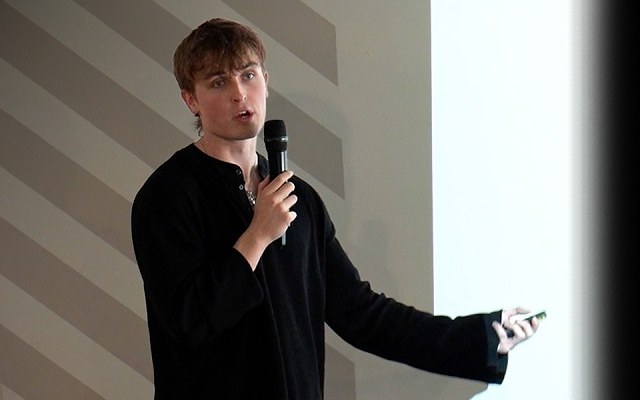
He speaks to founders, marketing teams and people building a career in YouTube strategy,
on three things: how a business turns YouTube attention into customer conversations, the
decisions behind a useful YouTube strategy, and how to build and develop a strategy team.
Formats run from keynotes and team workshops to podcasts, in person in the North East or
remote. Appearances include the 1of10 podcast and his recorded live training,
The Most Valuable YouTube Training You’ll Ever Watch.
Speaking enquiries go through the form on his own site and are answered by a person within
two working days.
Working with Jake
Views To Clients is a monthly retainer for businesses that sell to other businesses or
have a high-value offer, and it only makes sense when a few extra clients a month cover it.
Rather than a sales call, the route in from this site is the free
channel audit: it measures your channel, and if the results show a business channel with a
conversion problem worth solving, it offers a short qualification step and a call with the
team. If not, it says so and points you at the free tools instead. Channels are re-assessed
every time they re-audit, so a “not yet” is not a “no”.
See your channel the way Jake reads one
The free audit scores every video against your own median, shows what your winners share, and names the one fix to test first. No account needed to run it.
Run the free channel audit
Watch his channel
Common questions
Who is Jake Trinder?
Jake Trinder is the founder of Views To Clients (V2C), a YouTube growth company in Newcastle upon Tyne that builds and runs business YouTube channels end to end, and the co-owner of VideoCore, the YouTube channel-intelligence platform, with Niels Trinder. He started his first channel at ten, founded V2C at eighteen during a gap year, and his clients have included Gary Vee, Ali Abdaal, Instantly and Glencoco. He publishes his method openly on youtube.com/@jaketrinder.
What is Views To Clients?
Views To Clients is Jake Trinder's YouTube growth company for businesses: B2B software companies, agencies, consultants and experts with a high-value offer. The team does the buyer research, strategy, scripts, editing, thumbnails, publishing and lead tracking; the client records for a few hours a month. Every result it publishes came from organic videos, not paid ads. It is a monthly retainer and only a fit for businesses whose clients are valuable enough to cover it.
What is Jake Trinder's YouTube method?
Business first, then a niche you can win, then understanding the audience in their own words, then research before ideas (finding videos that beat their own channel's norm and transferring the pattern), then packaging that makes one promise the video keeps, then doubling down on what already worked, then selling without selling, and only ever claiming what was measured. He treats a video as a chain of viewer decisions, demand, choice, consumption and conversion, and fixes the one link that is failing.
How did Jake Trinder start Views To Clients?
By his own account, he left sixth form in 2022 with A* grades, was turned down by the universities he applied to, and made a bet with his parents: a gap year, and if he was earning ten thousand dollars a month by the end of it he would not have to go. He answered a business owner's post for a YouTube editor with a pitch to run the whole channel instead, at 1,700 dollars a month. He reports that channel added over a million dollars a year to the business within eight months, and the write-up of it brought the next clients.
Is Jake Trinder's method available for free?
Yes. He teaches it in full on his channel, and the longest lessons are written up as free guides on this site: the five-step framework for a profitable business channel, the depth-first research method for finding video ideas, the interview on making money from a small channel, and how to get clients from YouTube. VideoCore's free channel audit applies the same measurements to any public channel.
How do I work with Jake Trinder?
For a business channel, run the free VideoCore channel audit. If it shows a channel with a conversion problem worth solving, the results page offers a Views To Clients qualification step and a call with the team; if not, it says so and points you at the free tools. For speaking, podcasts and workshops, the enquiry form on his own site is answered by a person within two working days.
How big is Jake Trinder's own YouTube channel?
As of 25 September 2026 his channel @jaketrinder had about 15,600 subscribers, 763,000 total views and 21 public videos, and has been active since February 2021. Measured against his own channel median, his September 2026 talk "The Most Valuable YouTube Training You'll Ever Watch" reached 100 times his typical video within its first ten days.
Related free tools and guides
Last updated September 2026. Written by the VideoCore team. Channel figures and video multiples are measured by VideoCore; company results are Jake’s own statements, labelled as such.